How Can You Transform a Dark Basement with Strategic Lighting?
A man often views his basement as a blank canvas, yet the lack of natural light frequently hinders his vision for the space. Whether he is building a workshop, a retreat, or a functional living area, the right basement lighting ideas are essential to eliminate that subterranean feel. The goal is to move beyond a single flickering bulb and create a layered environment that feels as warm and inviting as the main floor.
To achieve this, he must consider the three pillars of lighting design: ambient, task, and accent. Ambient lighting provides the overall illumination, task lighting focuses on specific work areas, and accent lighting highlights architectural features or artwork. By balancing these three, he ensures that every corner of his lower level is both functional and aesthetically pleasing.
Choosing the Right Fixtures for Low Ceilings
Basements are notorious for having limited vertical clearance. If a man chooses the wrong fixtures, he risks making the ceiling feel even lower, or worse, creating a safety hazard. Recessed lighting, often called pot lights, is the gold standard for basement renovations in 2026. These fixtures sit flush within the ceiling, providing a clean, unobtrusive look that maximizes headspace.
For areas where recessed cans are not feasible due to ductwork or structural beams, ultra-thin LED wafers are an excellent alternative. These require very little clearance and provide a high lumen output. If he prefers a more industrial aesthetic, track lighting allows him to aim beams specifically where they are needed most without the need for extensive ceiling cutouts.
Integrating Smart Technology into Your Setup
In the modern era, a manual wall switch is often insufficient for a multi-purpose room. A man should look into automated systems that allow him to adjust the mood of his basement with a single command. The modern homeowner can easily manage his environment through seamless smart home integration with voice assistants to adjust brightness on the fly or set schedules for his daily routine.
Smart dimmers are particularly valuable. They allow him to transition the basement from a bright, high-energy gym in the morning to a low-light relaxation zone in the evening. Using smart bulbs also offers the ability to change color temperatures, shifting from a cool white for productivity to a warm amber for comfort.
Creative Ways to Mimic Natural Light
Since most basements lack windows, a man must get creative to trick the eye into sensing daylight. One effective method is the installation of faux windows or light boxes that use high-quality LED panels to simulate the appearance of a sunlit window. This can significantly reduce the feeling of being enclosed.
- Daylight Bulbs: Aim for a color temperature of 4000K to 5000K to mimic natural noon-time light.
- Reflective Surfaces: He should use glossy paints or mirrors to bounce light throughout the room.
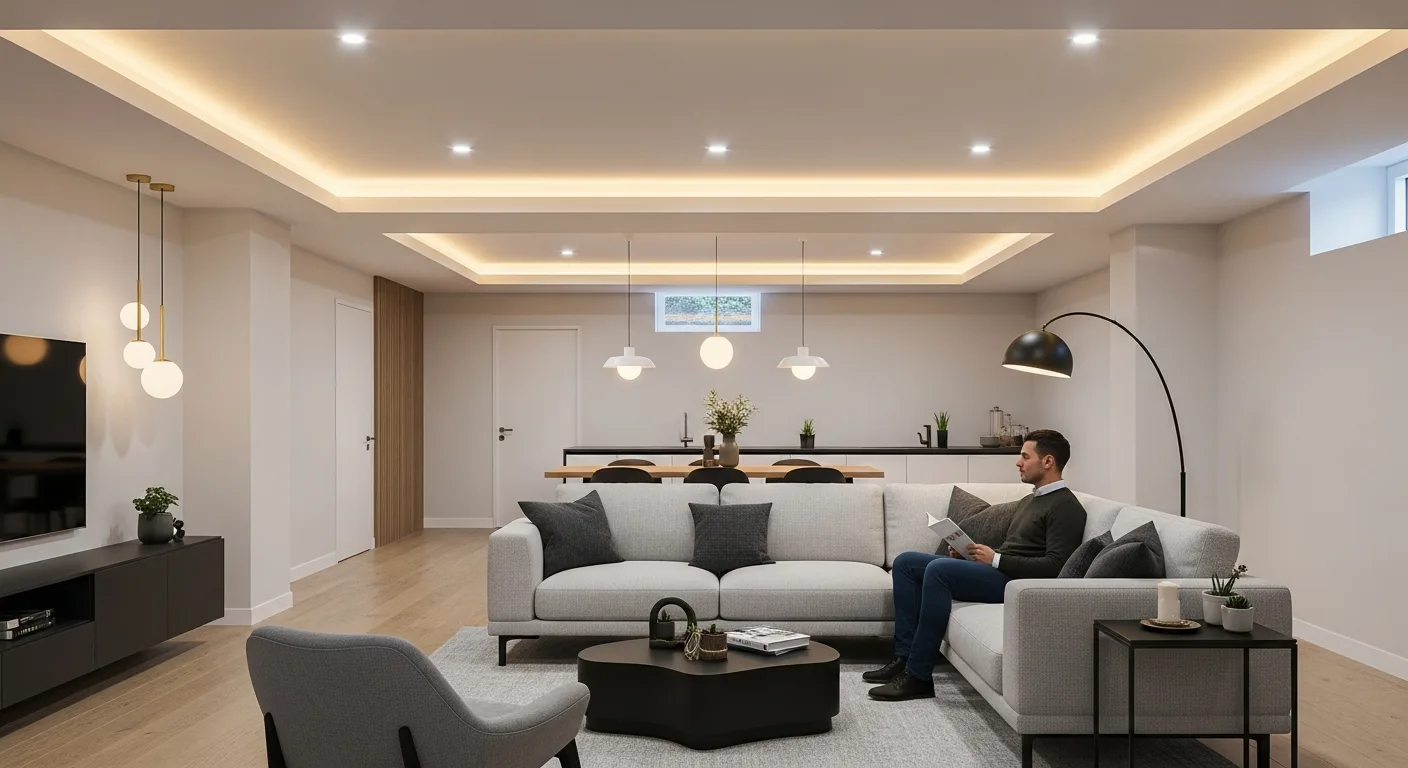
- Cove Lighting: Installing LED strips along the perimeter of the ceiling can create a “halo” effect that makes the ceiling appear higher.
Lighting for Specific Basement Zones
The layout of the lighting must follow the function of the room. If he has dedicated his basement to fitness, high-intensity overhead panels are necessary to keep his energy levels up. However, when he is setting up a specialized area, such as a basement home theater with proper acoustics, the lighting must be dimmable and directional to prevent glare on the screen while still allowing for safe movement.
In a home office zone, task lighting is paramount. A high-quality desk lamp with an adjustable arm ensures he has focused light for reading and technical work, reducing eye strain during long hours. For a basement bar or man cave, pendant lights over the counter can add a touch of masculine sophistication while providing essential illumination for hosting guests.