The Shift from Jack Stands to Professional Lifts
Every serious home mechanic reaches a point where crawling under a chassis on a cold concrete floor loses its appeal. The transition to a car lift for home garage use isn’t just about luxury; it is about ergonomics, safety, and efficiency. When a man can stand upright to change his oil or drop a transmission, his productivity doubles and the physical toll on his body vanishes. In 2026, the market for residential lifts has expanded, offering more compact and affordable options than ever before.
2-Post vs. 4-Post: Which Fits His Workflow?
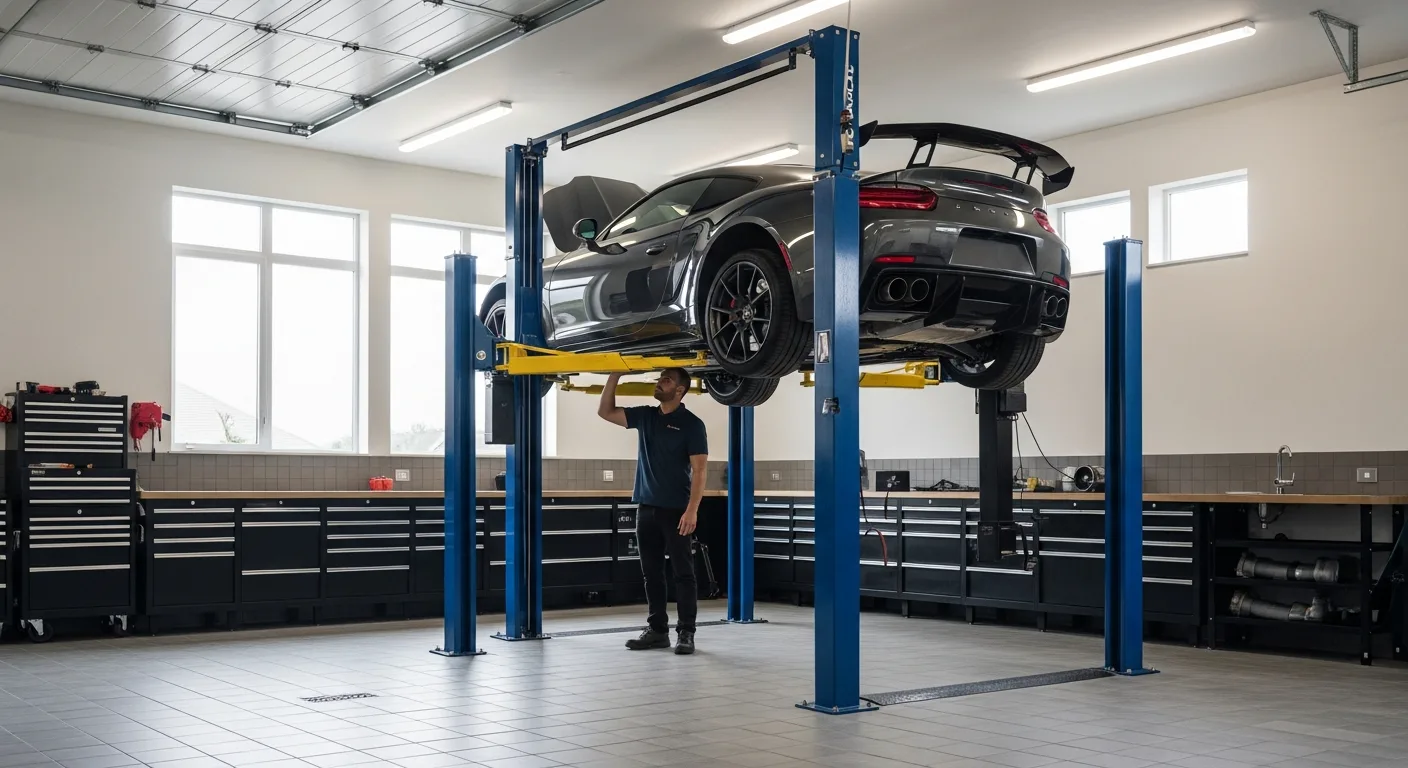
Choosing between a 2-post and a 4-post lift depends entirely on what he intends to do in his shop. A 2-post lift is the gold standard for suspension work and brake jobs. Because it lifts the vehicle by the frame, the wheels hang free, allowing him total access to the wheel wells and undercarriage. However, these require a more permanent installation and a thicker concrete slab to handle the concentrated stress.
On the other hand, a 4-post lift is the ultimate tool for storage and basic maintenance. He can drive right onto the ramps, making it much faster for oil changes or exhaust work. If he is looking to double his parking space by stacking one car over another, the 4-post is the superior choice. It is generally more stable and doesn’t always require the heavy-duty anchoring that a 2-post system demands.
Critical Structural Requirements for Installation
Before he hits the ‘buy’ button, he must audit his garage’s physical limits. Most residential car lifts require a minimum of 4 inches of reinforced concrete with a 3,000 PSI rating. If his floor is thin or cracked, the anchors could pull out under load, leading to a catastrophic failure. He should also measure his ceiling height accurately. While a standard 8-foot ceiling might accommodate a low-rise scissor lift, a full-sized 2-post lift typically requires at least 11 to 12 feet of clearance to fully utilize its range.
Beyond the floor, he needs to consider the layout of his workspace. If he is also managing a home gym setup with specific flooring and storage needs in the same area, he must ensure the lift’s footprint doesn’t interfere with his workout zone or equipment racks.
Powering the Lift: Electrical Considerations
Most professional-grade home lifts run on 220V power. While some smaller 110V models exist, they are often slower and have lower weight capacities. He will likely need to hire an electrician to run a dedicated circuit to the lift location. This is a great time to evaluate his entire garage’s power grid, especially if he is planning other electrical upgrades for EV charging or generators to ensure his home remains functional during a power outage.
- Amperage: Most 220V motors require a 20-30 amp breaker.
- Placement: The power unit should be mounted on the side of the lift where he has the most room to maneuver.
- Safety Switches: Ensure the lift has an automatic shut-off bar to prevent the vehicle from hitting the ceiling.
Safety Protocols for the Home Mechanic
A car lift is a powerful tool that demands respect. He should never rely solely on the hydraulic pressure to hold the vehicle up; the mechanical safety locks must be engaged before he steps under the car. Regular maintenance is also mandatory. He should inspect the cables for fraying, check the hydraulic fluid levels, and ensure the anchor bolts remain torqued to the manufacturer’s specifications every few months. If he hears any unusual popping or grinding, he must stop operation immediately and troubleshoot the issue.
Frequently Asked Questions
Can a standard garage floor support a car lift?
Most modern garage floors are 4 inches thick, which is the minimum requirement for many 4-post and some 2-post lifts. However, he should always verify the concrete depth and PSI before installation to ensure the anchors hold securely.
How much ceiling height do I need for a car lift?
For a full-rise lift, a ceiling height of 11 to 12 feet is ideal. If he has a standard 8 or 9-foot ceiling, he should look into “low-rise” or “mid-rise” scissor lifts which are designed for tighter spaces.
Are 2-post lifts safe for long-term storage?
While a 2-post lift can hold a car indefinitely, it is not recommended for long-term storage. The suspension remains loaded in an unnatural position, and the lift’s footprint is less stable than a 4-post lift for months of inactivity.