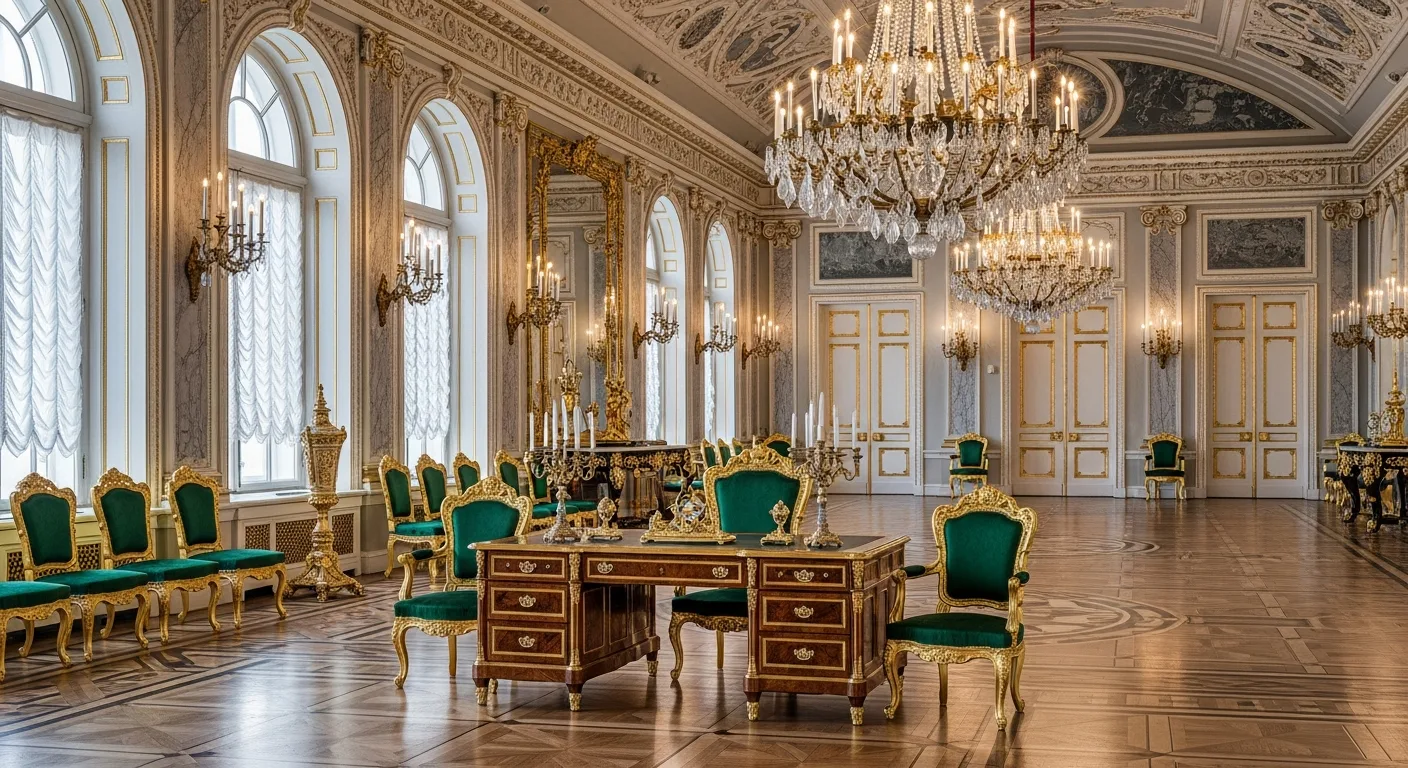
The Sovereign’s Vision for Russian Neoclassicism
The furniture commissioned during the reign of the Russian Sovereign represents a radical departure from the gilded excesses of the early 18th century. He sought to replace the whimsical curves of the Rococo with the disciplined, masculine lines of Neoclassicism. This shift wasn’t merely about aesthetics; it was a calculated move to align the Russian Empire with the Enlightenment values of Western Europe. By importing the finest minds in cabinetry, the Monarch transformed his palaces into galleries of architectural precision.
When studying these imperial pieces, one gains a deeper perspective by understanding the broader context of historical architecture styles that influenced the Russian court. The furniture was designed to complement the massive scale of the Winter Palace and the Hermitage, utilizing materials that signaled absolute power and vast territorial wealth.
David Roentgen: The Master of Mechanical Engineering
No artisan is more synonymous with this era than David Roentgen. He was not just a cabinetmaker; he was a visionary engineer who treated furniture as a complex machine. His pieces for the Sovereign often featured hidden drawers, disappearing compartments, and intricate clockwork mechanisms that allowed a simple writing desk to transform into a multi-functional workstation at the touch of a button.
- Mechanical Sophistication: Roentgen’s desks often contained weights and pulleys that operated silently, allowing the user to access secret ledgers.
- Marquetry Excellence: He used wood like a painter uses oils, creating “mosaics” of exotic timber that depicted classical ruins or floral arrangements.
- Ormolu Accents: Every piece was finished with fire-gilded bronze (ormolu) that protected the corners and added a shimmering, regal contrast to the dark mahogany.
Materials of the Empire: Malachite and Mahogany
The Sovereign demanded materials that reflected the geological riches of his land. While mahogany was imported for its stability and rich color, the use of malachite became a signature of the Russian Imperial style. This vibrant green stone was sliced into thin veneers and applied to tables, vases, and even entire fireplace mantels using a technique known as “Russian Mosaic.”
A modern collector looking to replicate this level of excellence should learn how to identify best quality furniture by examining the joinery and material density. In the 18th century, the weight of a piece often indicated the use of solid hardwoods and heavy bronze casting, features that remain hallmarks of high-end craftsmanship today.
The Legacy of the Hermitage Collection
Today, the most significant examples of this furniture reside in the State Hermitage Museum. These pieces are survivors of revolution and war, standing as a testament to the durability of 18th-century construction. The Sovereign’s patronage ensured that the Russian court became a hub for European talent, blending French elegance with German mechanical ingenuity and Russian material wealth.
He prioritized furniture that served as both a tool for governance and a symbol of status. The massive library tables and rolling-top desks were designed for a ruler who spent hours every day corresponding with the greatest philosophers of his time. Each piece was built to last centuries, utilizing dovetail joints and seasoned timbers that have resisted warping for over 250 years.
Frequently Asked Questions
What defines the style of Catherine the Great’s furniture?
The style is primarily Russian Neoclassicism. It is characterized by straight lines, classical motifs like acanthus leaves and lyres, and the heavy use of mahogany, ormolu, and Siberian semi-precious stones like malachite and lapis lazuli.
Who was the most famous cabinetmaker for the Russian Imperial Court?
David Roentgen was the most celebrated artisan. He was famous for his “mechanical” furniture, which featured complex internal gears and hidden compartments that fascinated the Sovereign and his court.
Why is malachite so common in Russian imperial furniture?
Malachite was abundant in the Ural Mountains of Russia. The Imperial family used it as a display of national wealth, developing the “Russian Mosaic” technique to cover large furniture surfaces with thin, perfectly matched slices of the green stone.
Are these furniture pieces still functional today?
Yes. Due to the exceptional quality of the seasoned wood and the precision of the metalwork, many of Roentgen’s mechanical pieces in museums are still fully operational, with drawers and panels that move as smoothly as they did in the 1780s.