The Economic Reality of Commercial LED Lighting
If a business owner is still paying for the maintenance of legacy fluorescent or HID systems, he is essentially burning cash. In 2026, the transition to commercial LED lighting is no longer a luxury; it is a fundamental requirement for operational efficiency. The primary driver is the drastic reduction in energy consumption, which typically drops by 50% to 75% immediately after installation.
Beyond the monthly utility bill, a facility manager must consider the Total Cost of Ownership (TCO). Traditional bulbs require frequent replacement, involving labor costs and specialized equipment like scissor lifts. LEDs, conversely, are rated for 50,000 to 100,000 hours. This means he can reallocate his maintenance team to more productive tasks rather than constantly swapping out burnt-out tubes.
Decoding the Specs: Lumens, Kelvins, and CRI
When a manager begins sourcing fixtures, he needs to look past the brand name and focus on the technical data sheet. The old way of measuring brightness by wattage is dead. Instead, he should focus on Luminous Efficacy—the ratio of lumens produced to watts consumed. A high-quality commercial fixture should deliver at least 130 lumens per watt.
- Color Temperature (Kelvin): For warehouses, 5000K (Daylight) improves alertness. For office environments, 3500K to 4000K provides a balanced, professional atmosphere.
- Color Rendering Index (CRI): In retail or automotive showrooms, a CRI of 90+ is necessary so the products look exactly as they should under natural light.
- L70 Rating: This indicates how long the LED will take to reach 70% of its original light output. It is the industry standard for measuring lifespan.
Application-Specific Lighting Strategies
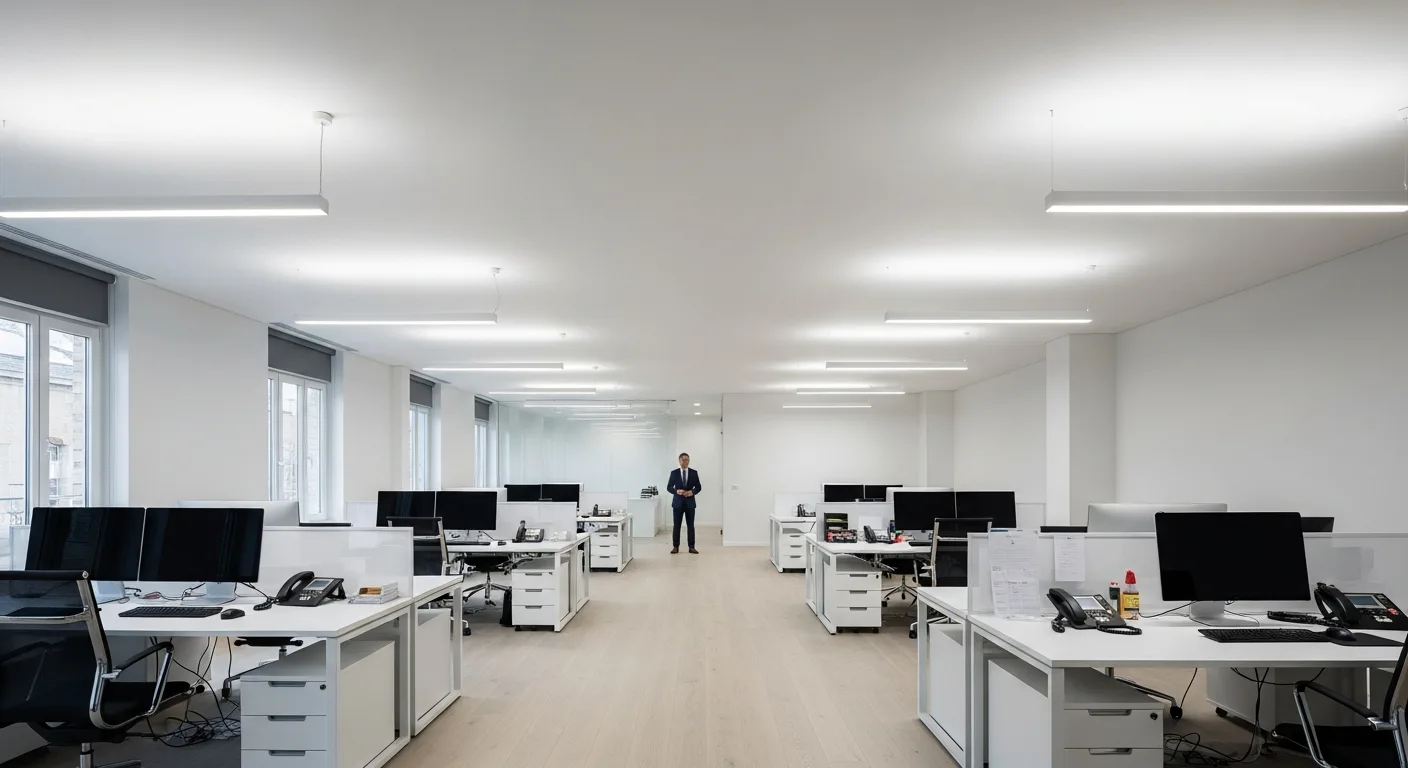
Every commercial space has unique demands. A warehouse manager requires High-Bay LEDs with narrow beam angles to penetrate deep into racking aisles. In contrast, an office manager needs LED Troffers or flat panels that provide uniform, flicker-free light to reduce eye strain for his employees.
A business owner must also consider how his interior illumination complements his exterior setup; often, a comprehensive commercial landscape lighting strategy is the first step in creating a professional brand image before a client even walks through the door. High-output floodlights and wall packs ensure the perimeter is secure and welcoming.
The Role of Smart Sensors and Automation
The most efficient light is the one that is turned off when not needed. Modern commercial systems integrate occupancy sensors and daylight harvesting. Daylight harvesting uses photosensors to detect natural light coming through windows and automatically dims the LEDs to maintain a consistent light level, further slashing energy use.
Before a facility manager commits to a massive lighting overhaul, he should verify if his current panel can handle the load or if he needs broader electrical upgrades and infrastructure improvements to support 2026-standard smart systems. Integrating lighting into a Building Management System (BMS) allows him to monitor energy usage in real-time and identify further areas for cost-cutting.
Installation and Retrofitting
He has two main paths: Retrofitting or Full Fixture Replacement. Retrofitting involves keeping the existing housing and replacing only the lamps and ballasts. This is faster and cheaper upfront. However, a full fixture replacement often yields better light distribution and longer warranties. If he is planning a long-term stay in his current facility, the full replacement is almost always the superior financial move.
Frequently Asked Questions
How much can I save by switching to commercial LEDs?
Most businesses see a 50% to 80% reduction in lighting-related energy costs. When you factor in the lack of maintenance and bulb replacements, the ROI typically hits within 12 to 24 months.
What is the difference between DLC and Energy Star ratings?
DLC (DesignLights Consortium) is the standard for commercial-grade lighting, while Energy Star is more common for residential products. Most utility rebate programs require DLC-listed fixtures to qualify for cash-back incentives.
Can I use my existing dimmers with new LED fixtures?
Usually, no. Commercial LEDs often use 0-10V dimming protocols, which are different from the phase-cut dimmers used for older incandescent or fluorescent lights. A contractor will need to install compatible dimming switches.
Do LEDs produce heat?
While LEDs are much cooler than HID or halogen bulbs, they still generate heat at the base of the diode. High-quality fixtures use aluminum heat sinks to dissipate this heat, ensuring the electronics don’t overheat and fail prematurely.